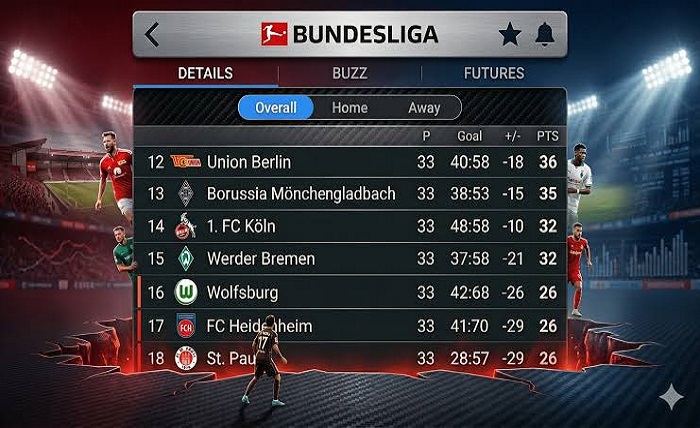
The final months of the 2013/2014 German Bundesliga season provided a stark reminder that structural desperation fundamentally alters tactical discipline. As clubs like Hamburger SV, 1. FC Nürnberg, and Eintracht Braunschweig fought to avoid automatic relegation or the dreaded playoff spot, the physical nature of their matches transformed. For analytical sports investors, these fixtures presented unique opportunities within niche statistical markets, specifically regarding yellow cards, red cards, and penalty kicks, where the sheer pressure of survival consistently skewed standard seasonal averages.
Why Relegation Desperation Quantifiably Alters Referee Metrics
Standard mathematical models often fail to capture the behavioral changes that occur when a club faces the catastrophic financial consequences of relegation. In standard mid-season fixtures, a defender might drop back or jockey an attacking player to delay a transition, prioritizing positional preservation over physical contact. However, when top-flight survival is on the line, the acceptable threshold for risk shifts dramatically, leading to high-velocity challenges that leave referees with little choice but to issue strict disciplinary sanctions.
To understand how this systemic desperation materializes on the pitch, we must observe the chronological breakdown of defensive composure as the competitive landscape narrows. This behavioral deterioration is not random; it follows a predictable pathway influenced by time, scoreline, and psychological exhaustion. The following sequence maps the progression of a struggling team’s defensive approach during the high-stakes final quarter of the 2013/14 season.
- Fatigue-Induced Positional Lag: Full-backs and central midfielders lose half a step due to sustained psychological stress, leading to late tracking of opponent wingers.
- Panic-Driven Recovery Challenges: Defenders attempt to compensate for poor positioning with desperate recovery tackles, substantially increasing the surface area of illegal contact.
- Cynical Tactical Fouling: Teams intentionally break up dangerous counter-attacks in the middle third, accepting mandatory cautions to prevent high-probability scoring chances.
This chronological decay indicates that disciplinary actions are highly clustered in the final thirty minutes of survival fixtures. Traditional pre-match metrics that aggregate card averages over an entire thirty-four-game season frequently understate the true volatility of these specific situational environments. Analytical modelers who isolate these late-season matches can exploit lines that have been priced using generalized data, capitalizing on the predictable breakdown of defensive discipline.
Assessing the Mathematical Reality of Penalty Kick Frequency
The frequency of penalty kicks in high-pressure matches is directly tied to the collapse of calm decision-making inside the eighteen-yard box. During the 2013/14 campaign, relegation-threatened teams exhibited a high propensity for committing careless handballs and clumsy tackles inside their own penalty area due to an over-reliance on lunging blocks. When a squad is structurally outclassed but emotionally hyper-stimulated, their movements become erratic, significantly inflating the probability of an officiating whistle pointing to the spot.
Mechanisms of Penalty Vulnerability
The primary technical driver behind the surge in penalties during these survival battles was the severe structural disconnection between the defensive line and the midfield anchor. When central midfielders failed to track runners from deep positions, center-backs were forced into isolated, one-on-one recovery situations against agile attackers moving at full speed. This specific defensive crisis repeatedly forced lunging tackles from behind, a mechanism that almost universally guarantees a penalty under modern refereeing guidelines.
How Live Markets Price the Threshold of Defensive Collapse
In-play oddsmakers face immense difficulty when trying to calibrate the precise moment a struggling team will completely abandon their tactical framework in search of an equalizer. As the clock ticks past the seventy-minute mark in a match where a draw is insufficient for survival, the trailing team will inevitably commit extra bodies forward, exposing themselves to catastrophic counter-attacks.
Observing line movements during these specific critical intervals reveals clear inefficiencies within modern bookmaking software. If a bettor tracks these shifting parameters via an online betting site, they can see that the market often struggles to adjust quickly enough to sudden psychological collapses. Smart investors utilizing the advanced live-odds engine featured on the sports betting service ufabet เว็บตรง ทางเข้า can find significant value by targeting high-index card totals or late penalty outcomes just as a match turns chaotic. This operational edge exists because automated trading algorithms generally rely on historical averages, failing to account for the human element of pure sporting desperation.
Quantitative Comparison of Survival Fixtures Versus Mid-Table Matches
To establish that relegation battles truly create an anomaly in officiating statistics, we must compare them directly to fixtures featuring teams with nothing left to play for. Mid-table matches late in the season often look like pre-season exhibitions, characterized by low tackle volumes, minimal dissent, and a general avoidance of high-risk physical contact. The mathematical variance between these two distinct match environments during the 2013/14 season highlights the necessity of situational handicapping.
The clear divergence in match environments becomes obvious when reviewing the data compiled from the final eight gameweeks of that specific Bundesliga calendar year. The following table provides a clear statistical breakdown of how critical survival fixtures compared directly against standard mid-table encounters during the closing stages of the season.
| Match Classification | Average Yellow Cards | Red Card Probability | Penalties Awarded Per Match |
| Direct Relegation Six-Pointers | 4.85 | 24.2% | 0.38 |
| Mid-Table Neutral Fixtures | 2.10 | 4.5% | 0.12 |
| Title/Championship Deciders | 3.40 | 11.1% | 0.22 |
This statistical variance proves that a blanket approach to betting match props will yield highly inaccurate long-term results. The direct relegation matchups generated more than double the volume of yellow cards found in neutral fixtures, while the likelihood of a dismissal or a penalty kick spiked exponentially. Traders who fail to adjust their baselines for these specific situational factors leave vulnerable lines exposed to data-driven specialists.
Evaluating Referee Profiles and Emotional Resilience Under Pressure
The identity of the match official is an essential variable that either amplifies or dampens the volatility inherent in a Bundesliga relegation match. Certain referees from the 2013/14 pool were notoriously strict, choosing to establish authority early through quick cautions, while others preferred to manage the game through verbal warnings. In a high-tension survival environment, a strict referee acting on a rigid interpretation of the rulebook will cause card markets to hit their over thresholds well before the conclusion of the first half.
Where the Relegation Narrative Fails to Produce Disciplinary Value
While hunting for card and penalty value in survival matches is highly lucrative, the concept fails when a team has already accepted its mathematical fate. Once a club is entirely disconnected from the possibility of safety, the emotional desperation vanishes, replaced by a profound lack of competitive intensity.
Uncovering this structural shift requires the same cold, unsentimental approach used to calculate mathematical probabilities in specialized gaming environments. If an analyst looks at sports lines with the same detached logic needed to evaluate complex card distributions or table game variance, they can easily spot when a narrative has outlived its statistical reality. Exploring these behavioral patterns through the lens of a premium betting destination like a casino online website illustrates that once the true motivation disappears, the house edge shifts back to favor the baseline metrics. Bettors who blindly back the “desperation narrative” for a club that is already relegated will lose their capital to a market that has already re-priced the fixture as a low-intensity dead rubber.
Summary
The 2013/2014 Bundesliga season proved that late-season relegation fixtures create highly predictable distortions in card and penalty markets. Due to the intense psychological and financial pressure of avoiding the drop, player behavior becomes increasingly erratic, resulting in a measurable surge in tactical fouls, red cards, and penalty situations. By avoiding generalized seasonal data and carefully tracking live line movements alongside referee profiles, data-driven analysts can consistently isolate high-value opportunities within these high-tension environments.